NVMe HDDs are coming soon to a data center near you, but don’t expect one to land in your PC before the next decade (if ever)

- Seagate NVMe HDDs may unify storage protocols, but don’t expect speed records
- Enterprise systems might love NVMe HDDs, but gamers and creators won’t benefit anytime soon
- NVMe brings storage consistency, but SAS still holds its ground in raw performance terms
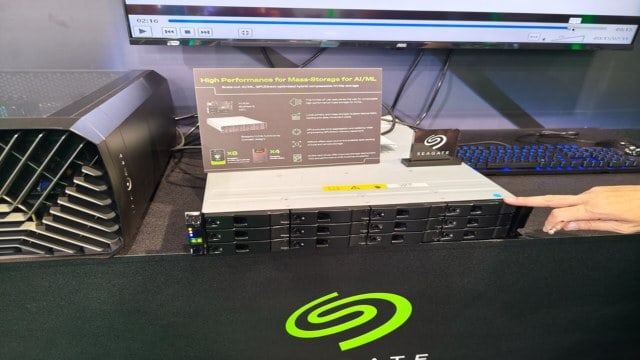
Seagate Technology demonstrated a prototype hard drive at Computex 2025 that utilizes NVMe, a storage protocol typically found in SSDs.
According to PCwatch, the demonstration featured a combination of NVMe SSDs and HDDs using NVMe-oF (NVMe over Fabrics) to communicate over Ethernet.
While the hybrid interface showcased potential for data centers, it remains unclear whether this shift will be feasible for personal computers.
NVMe integration marks a shift in storage interfaces, not performance
Colin Pressley, Seagate’s Head of Customer Success, noted, “We have already natively integrated PCIe into our HDD controllers,” signaling a major architectural shift.
The prototype drive supports both NVMe and SAS connections, offering flexibility during what could be a lengthy transition.
However, Pressley was quick to manage expectations: “There are almost no benefits in terms of performance. The latest SAS provides sufficient performance, and just because it becomes NVMe doesn’t mean that there is a major improvement.”
For consumers searching for the best HDD, or even the fastest external HDD, NVMe support offers little immediate benefit.
The real promise lies not in speed, but in unification. With SSDs already running on NVMe, bringing HDDs under the same protocol simplifies driver requirements and software architecture.
Importantly, the NVMe-compatible HDD is not based on a proprietary standard. Instead, it follows a formalized version of the NVMe specification, which now includes commands tailored to mechanical drives, such as spin-up protocols.
This adherence to open standards increases the likelihood of broader industry adoption, especially in enterprise environments where consistency is crucial.
However, NVMe HDDs are unlikely to become available to the general public anytime soon. According to Pressley and Seagate, it may take five to ten years for hard drives to fully transition from SATA/SAS to NVMe.
That timeline mirrors previous transitions, like the shift from IDE to SATA, where new standards gradually replaced legacy interfaces.
While this progression seems inevitable for data centers, consumer desktops and laptops are a different story.
Most consumer systems today still rely on SATA for bulk storage, often pairing the largest HDD available with a faster SSD for boot and application performance.
Until motherboard chipsets eliminate SATA support altogether, a shift not expected for at least another decade, NVMe HDDs are unlikely to become mainstream in home PCs.
You might also like
Seagate NVMe HDDs may unify storage protocols, but don’t expect speed records Enterprise systems might love NVMe HDDs, but gamers and creators won’t benefit anytime soon NVMe brings storage consistency, but SAS still holds its ground in raw performance terms Seagate Technology demonstrated a prototype hard drive at Computex 2025…
