Valve CEO Gabe Newell’s Neuralink competitor is expecting its first brain chip this year

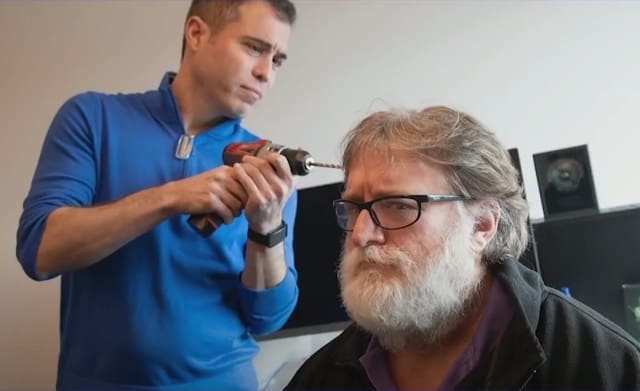
Valve co-founder and CEO Gabe Newell, the company behind Half-Life and DOTA 2 and Counter-Strike and preeminent PC game distribution platform Steam, has long toyed with the idea that your brain should be more connected to your PC. It began over a decade ago with in-house psychologists studying people’s biological responses to video games; Valve once considered earlobe monitors for its first VR headset. The company publicly explored the idea of brain-computer interfaces for gaming at GDC in 2019.
But Newell decided to spin off the idea. That same year, he quietly incorporated a new brain-computer interface startup, Starfish Neuroscience — which has now revealed plans to produce its very first brain chip later this year.
Starfish’s first blog post, spotted by Valve watcher Brad Lynch, makes it clear we’re not talking about a complete implant yet. This bit is the custom “electrophysiology” chip designed to record brain activity (like how Neuralink can “read your mind” so patients can interact with computers) and stimulate the brain (for disease therapy), but Starfish isn’t claiming it’s already built the systems to power it or the bits to stick it into a person’s head.
“We anticipate our first chips arriving in late 2025 and we are interested in finding collaborators for whom such a chip would open new and exciting avenues,” writes Starfish neuroengineer Nate Cermak (bolding theirs), suggesting that Starfish might wind up partnering with other companies for wireless power or even the final brain implant.
But the goal, writes Starfish, is a smaller and less invasive implant than the competition, one that can “enable simultaneous access to multiple brain regions” instead of just one site, and one that doesn’t require a battery. Using just 1.1 milliwatts during “normal recording,” Starfish says it can work with wireless power transmission instead.
Here’s the chip’s current spec sheet:
Neuralink’s N1, for comparison, has 1,024 electrodes across its 64 brain-implanted threads, a chip that consumed around 6 milliwatts as of 2019, a battery that periodically needs wireless charging, and the full implant (again, not just the chip) is around 23mm wide and 8mm thick. The Elon Musk-led company has reportedly already implanted it in three humans; while some of the threads did detach from the first patient’s brain, he still has functionality and has been giving interviews.
Starfish says it could be important to connect to multiple parts of the brain simultaneously, instead of just one region, to address issues like Parkinson’s disease. “there is increasing evidence that a number of neurological disorders involve circuit-level dysfunction, in which the interactions between brain regions may be misregulated,” Cermak writes.
In addition to multiple simultaneous brain implants, the company’s updated website says it’s working on a “precision hyperthermia device” to destroy tumors with targeted heat, and a brain-reading, robotically guided transcranial magnetic stimulation (TMS) system for addressing neurological conditions like bipolar disorder and depression.
In case you’re wondering how any of this might make its way back to gaming, I’ll leave you with Valve’s talk from GDC 2019 about brain-computer interfaces.
Valve co-founder and CEO Gabe Newell, the company behind Half-Life and DOTA 2 and Counter-Strike and preeminent PC game distribution platform Steam, has long toyed with the idea that your brain should be more connected to your PC. It began over a decade ago with in-house psychologists studying people’s biological…
