Border agents are going to photograph everyone leaving the US by car

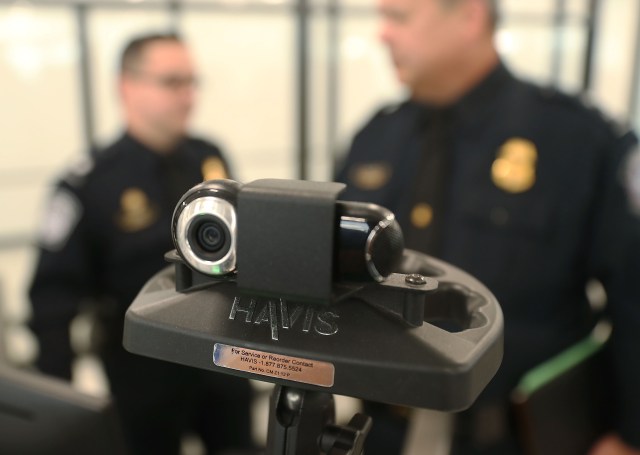
Customs and Border Protection (CBP) plans on photographing every single person who leaves the US by car, an agency spokesperson told Wired. The agency says it will start using facial recognition technology at official border crossings to match all outbound travelers’ faces to their passports, visas, or other travel documents, though there’s no public timeline for when this will happen.
“Although we are still working on how we would handle outbound vehicle lanes, we will ultimately expand to this area,” CBP spokesperson Jessica Turner told Wired. It’s an expansion of the agency’s current practice of photographing travelers as they enter the country and matching those photos with “all documented photos, i.e., passports, visas, green cards, etc,” the agency has on record.
CBP has been working on ways to track people as they leave the US for over a decade. After two years of lab tests, CBP experimented with collecting travelers’ biometrics at airports in 2016. That year, the agency partnered with Delta Air Lines to photograph passengers boarding a Tokyo-bound flight at Hartsfield-Jackson Atlanta International Airport.
The agency’s collection of outgoing travelers’ biometric data has expanded since then. CBP currently uses “biometric facial comparison technology” to process travelers exiting the US at 57 airports, including Hartsfield-Jackson in Atlanta, Los Angeles International Airport, Dallas-Fort Worth International Airport, and John F. Kennedy International Airport in New York — some of the busiest airports in the country. The airport panopticon continues to expand.
“We found that facial recognition was intuitive for people. Everybody knows how to stand in front of a camera and have his or her photo taken,” John Wagner, the deputy assistant commissioner of CBP’s office of field operations, said in an agency article promoting CBP’s biometric technologies. “Not so with iris scans and fingerprints. Every time a traveler does the process wrong, someone has to instruct him or her the right way to do it.”
Collecting passengers’ fingerprints may be less intuitive than taking their pictures, but CBP does that, too. Agents stationed at airports across the country use a handheld device called Biometric Exit Mobile to take certain travelers’ fingerprints before they board their flights. Those fingerprints are then run against law enforcement databases.
If CBP’s role is to process people for entry into the US, why track people on the way out? Wired notes that biometric databases could be used to monitor self-deportations. Having realized that the Department of Homeland Security (DHS) lacks the resources to arrest, detain, and deport each and every one of the estimated 11 million undocumented immigrants living in the US, President Donald Trump is encouraging undocumented immigrants to leave the US on their own, offering people $1,000 if they leave the country voluntarily.
But CBP was devising ways to collect travelers’ photos, fingerprints, and other biometric data long before Trump took office. The agency says it collects this data to run people’s biometrics against law enforcement databases, therefore ensuring that people with criminal records are removed from the US. The agency’s promotional article touting its biometric technologies includes a “success story” involving a Polish couple who had “criminal histories with multiple identities” caught leaving the US under false names. Since DHS’s formation in the wake of the September 11th attacks, immigration enforcement has blurred the lines between criminal enforcement and national security. Every international traveler is a potential criminal or terrorist, justifying mass surveillance.
Trump didn’t invent this playbook. But his mass deportation agenda is getting a helpful boost from decades of bipartisan turbocharging of the surveillance state.
Customs and Border Protection (CBP) plans on photographing every single person who leaves the US by car, an agency spokesperson told Wired. The agency says it will start using facial recognition technology at official border crossings to match all outbound travelers’ faces to their passports, visas, or other travel documents,…
