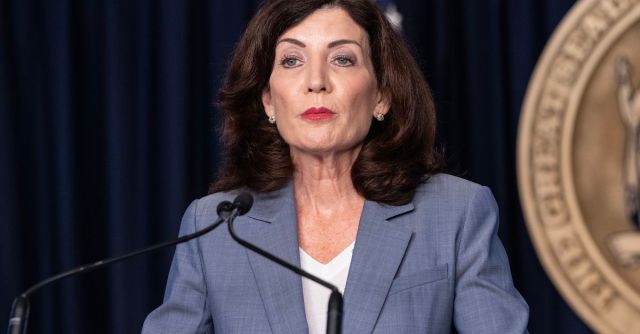
New York governor Kathy Hochul signed landmark climate legislation into law last week, showing how states can keep holding polluters accountable even when President-elect Donald Trump rolls back environmental protections.
How New York state is defying Donald Trump’s plans to roll back climate action

New York’s Climate Change Superfund Act will require the biggest multinational oil and gas companies to contribute to a fund that’ll be used for infrastructure projects meant to protect New York residents from increasingly dangerous climate disasters like storms and sea level rise.
“New York has fired a shot that will be heard round the world”
Trump will soon step back into office and is expected to dismantle existing climate policies and gut the Environmental Protection Agency (EPA), having openly disparaged clean energy and federal environmental regulations on the campaign trail. So for the next four years at least, Americans will have to rely on local and state efforts like this to deal with the pollution from fossil fuels that’s causing climate change.
“New York has fired a shot that will be heard round the world: the companies most responsible for the climate crisis will be held accountable,” State Senator Liz Krueger said in a statement after Hochul signed the Climate Change Superfund Act into law.
Krueger’s office expects the law to generate $75 billion over the next 25 years. But in the immediate future, the New York State Department of Environmental Conservation (DEC) will first have to propose guidelines for how the fund works. That includes rules for who has to pay into the fund, how the state collects the money, and what kinds of infrastructure projects the fund will support. The law will apply to fossil fuel companies historically responsible for more than 1 billion tons of greenhouse gas emissions. And at least 35 percent of the benefits of the fund are supposed to reach “disadvantaged” communities.
The plan is loosely modeled after state and federal laws that have been in place for decades to hold companies responsible for toxic waste sites they leave behind. But instead of directing funds to cleaning up hazardous substances at old industrial sites, New York’s new law would fund resiliency projects such as upgrading storm water drainage systems.
“New York taxpayers were 100 percent on the financial hook for climate costs. Now Big Oil will pay for much of the damages that they helped cause,” New York Public Interest Research Group (NYPIRG) Executive Director Blair Horner said in a press release.
The Climate Change Superfund Act is supposed to reduce New Yorkers’ future tax burden by $3 billion each year, according to NYPIRG. Extreme weather events exacerbated by climate change are expected to cost half a trillion dollars in preparation and recovery efforts in New York by 2050, Kreuger’s office says.
Joe Biden set a goal of slashing US greenhouse gas emissions by at least 50 percent by 2030 compared to 2005 pollutions levels as part the country’s commitment to the Paris climate accord. He also signed the Inflation Reduction Act into law, a massive spending package that set aside $369 billion for climate action and clean energy technologies.
Trump, on the other hand, says he’ll take the US out of the Paris agreement again (which he briefly did during his first term before Biden recommitted the US to the accord). The President-elect has also said that he’ll rescind any unspent funds from the Inflation Reduction Act. He rolled back more than 100 environmental regulations when he was last president, and says that his pick for the Environmental Protection Agency this time around will ensure “swift deregulatory decisions” at the agency once again.
Still, state laws can make up for some of the ground lost in the fight against climate change. New York’s Climate Superfund Act will have to survive any legal challenges, of course. But this isn’t the first time the state has made ambitious environmental plans while facing hostility toward climate action from Trump. In 2019, New York state passed its Climate Leadership and Community Protection Act. That put the state on a path to slashing its greenhouse gas emissions by 40 percent by 2030, although progress has been slow since then.
New York’s latest answer to the environmental deregulation looming on the horizon is just one part of a larger trend that marked the first Trump presidency, and is poised to be part of the second. Earlier this year, Vermont passed its own Climate Superfund law. Similar legislation has also been introduced in California, Maryland, Massachusetts, New Jersey, and in Congress, according to the nonprofit Food & Water Watch.
New York governor Kathy Hochul signed landmark climate legislation into law last week, showing how states can keep holding polluters accountable even when President-elect Donald Trump rolls back environmental protections. New York’s Climate Change Superfund Act will require the biggest multinational oil and gas companies to contribute to a fund…
