Google says it just made a huge step forward in quantum computing
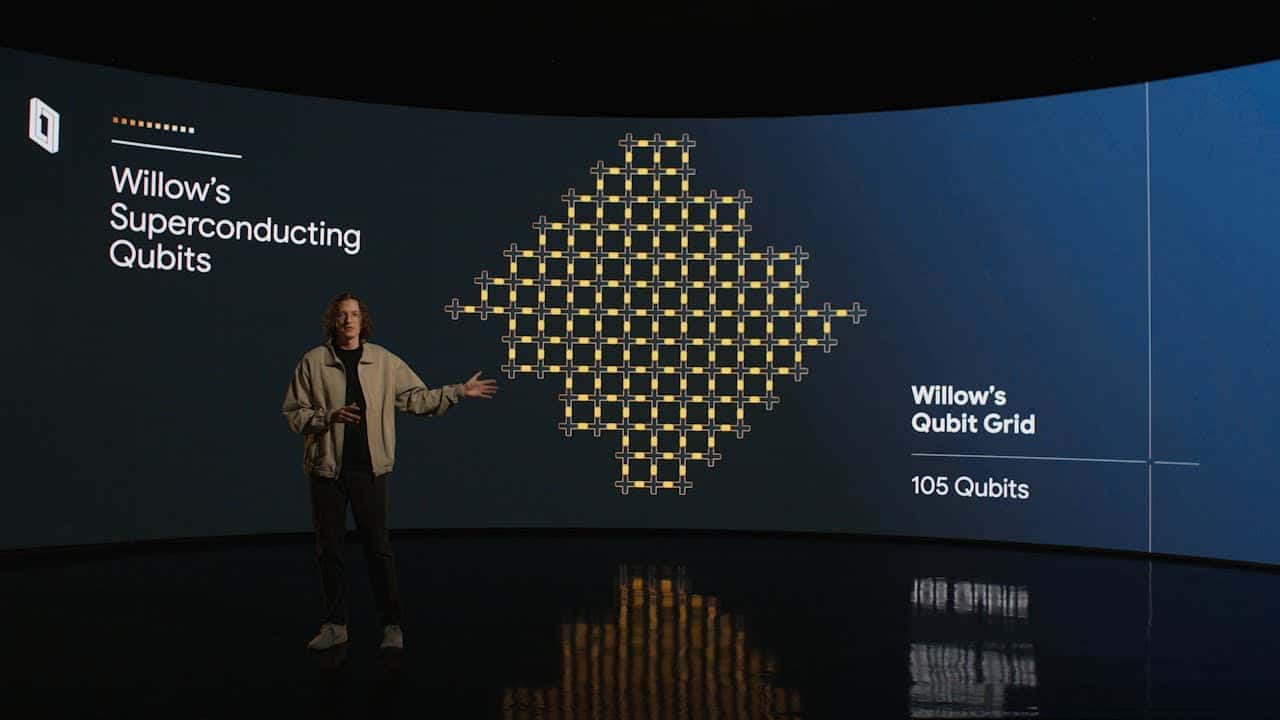
- Google unveils Willow quantum chip, promises major leaps forward
- Willow can outperform previous generations of chips across a range of benchmarks
- The chip has the potential for exponential error reduction – a key milestone
Google has unveiled a new quantum chip capable of exponential error reduction – a huge milestone in the journey towards quantum advantage.
The release of Willow, marks the second milestone in Google’s journey towards creating a large error-corrected quantum computer.
When tested using the random circuit sampling benchmark, Willow was able to complete the benchmark in five minutes – just slightly faster than the world’s current fastest supercomputer, which would take 10,000,000,000,000,000,000,000,000 years.
One small step for quantum computation

The chip was made at Google’s purpose-built Santa Barbara lab, with Willow housing 105 qubits. A qubit is quantum’s equivalent of a ‘bit’ used in classical computing, with the difference being that a qubit can exist as both a binary one and zero at the same time thanks to a qubit’s ability to exist in a state known as superposition.
Willow’s qubits are also capable of retaining their state of excitation, their ‘one’ state in binary terms, for almost 100 microseconds – five times longer than previous generations of chips produced by Google.
While the benchmarks performed by Willow are impressive, they are just a step in the journey towards creating a viable quantum computer that provides an actual advantage over a classic computer. Current quantum computers may be faster at solving certain problems, but classic computing is better optimized for a wider range of tasks that are not only scientifically viable, but also commercially.
In a blog postannouncing the launch, Hartmut Neven, Founder and Lead, Google Quantum AI, states, “On the one hand, we’ve run the RCS benchmark, which measures performance against classical computers but has no known real-world applications. On the other hand, we’ve done scientifically interesting simulations of quantum systems, which have led to new scientific discoveries but are still within the reach of classical computers.”
You might also like

Google unveils Willow quantum chip, promises major leaps forward Willow can outperform previous generations of chips across a range of benchmarks The chip has the potential for exponential error reduction – a key milestone Google has unveiled a new quantum chip capable of exponential error reduction – a huge milestone…
