World’s largest PCIe Gen5 SSD gets tested and reaches almost 13GBps in sequential read; 60TB Micron 6550 Ion is super fast as it swaps QLC for TLC

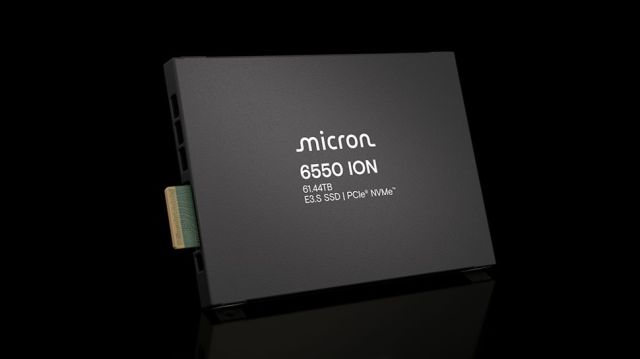
- Micron 6550 Ion SSD comes in 30.72TB and 61.44TB capacities
- PCIe Gen5 G8 TLC NAND improves performance and efficiency
- Sequential read write speeds are over 12GBs and 5GBs respectively
Modern data centers require high-capacity, energy-efficient SSD storage solutions to support data-intensive applications like AI and machine learning.
Addressing these needs, Micron has introduced the 6550 Ion SSD, available in 30.72TB and 61.44TB capacities.
The 6550 Ion SSD, which Micron is positioning as the “world’s fastest, most energy-efficient 60TB data center SSD,” is available in various form factors, including E1.L and U.2, but it’s the E3.S model which really shines, with its 61.44TB of TLC NAND.
Better performance than expected
Previously, in order to deliver a capacity of 61.44TB, manufacturers needed to use QLC NAND, but by making the switch to Gen5 interface G8 TLC NAND, Micron is able to offer faster write performance, endurance, and the thing that data centers are increasingly craving – energy efficiency.
StorageReview tested the new drive, and came away impressed, as reviewer Brian Beeler notes: “The Micron 6550 Ion offers massive performance and capacity benefits over the 6500 Ion, its predecessor. It adheres to PCIe Gen5 standards and incorporates future-proofing capabilities through OCP 2.5. Micron has prioritized security in the 6550 Ion, ensuring TAA and FIPS 140-3 L2 certifiability and a comprehensive security suite.”
In terms of performance, Micron says the 6550 Ion delivers sequential read speeds of 12GB/s and write speeds of 5GB/s while maintaining a maximum power consumption of 20W. StorageReview‘s test recorded read speeds of 12.7GB/s and writes of 8.2GB/s, better than expected.
The review compared the 6550 Ion against the Solidigm P5336, the only 61.44TB SSD widely shipping today, and while acknowledging it wasn’t an even match, said, “We noted many areas where the newer Gen5 interface on the Micron 6550 Ion excelled over the Gen4 interface in the P5336, which is expected. The difference between Gen4 vs. Gen5 drives relates to how much bandwidth each drive can push across the wire. The Gen4 PCIe interface with four lanes of connectivity is capable of around 7GB/s, while the newer Gen5 PCI interface doubles that with 14GB/s. Micron’s use of TLC NAND gives it another design advantage over QLC-based competitors.”
Energy efficiency is another key selling point of the 6550 Ion. It uses up to 20% less power than competing SSDs and supports multiple operational power states. For example, Power State 1 (PS1) limits power usage to 20W, compared to the maximum 25W. It also consumes ≤5W when idle.
The 61.44TB capacity of the 6550 Ion is impressive, but it’s set to be dwarfed when the PCIe Gen5 Phison Pascari D205V (offered in U.2 and E3.L formats) arrives in Q2 2025. As well as a 61.44TB model, there will also be one with double the capacity, 122.88TB, and it will be interesting to see how that compares in terms of performance.
You might also like

Micron 6550 Ion SSD comes in 30.72TB and 61.44TB capacities PCIe Gen5 G8 TLC NAND improves performance and efficiency Sequential read write speeds are over 12GBs and 5GBs respectively Modern data centers require high-capacity, energy-efficient SSD storage solutions to support data-intensive applications like AI and machine learning. Addressing these needs,…
