Chinese scientists use americium to produce ultra-compact nuclear battery that could perhaps one day replace lithium batteries

Scientists from across several Chinese institutions have unveiled a new ultra-compact nuclear battery that has the potential to replace the existing power sources used in everyday tech.
Powered by Americium, this new battery reportedly achieves an energy conversion efficiency up to 8,000 times greater than previous models, suggesting it could one day serve as a substitute for conventional lithium batteries.
These micronuclear power sources generate electricity by utilizing the radioactive decay of radioisotopes, producing power on a small scale typically measured in nanowatts or microwatts. Unlike chemical batteries, their lifespan depends on the half-life of the radioisotope used. Americium, specifically isotopes 241Am and 243Am, offers operational lifetimes extending over several decades, suggesting it could provide a long-term power solution.
Deep space exploration
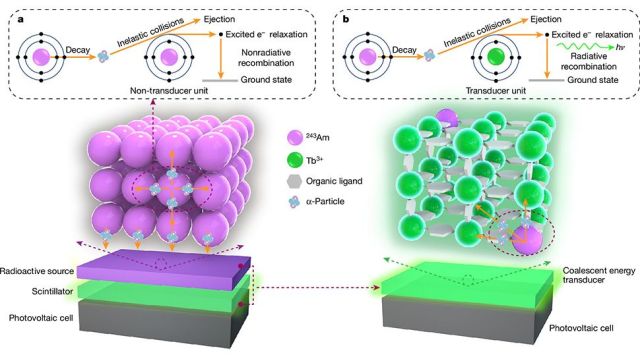
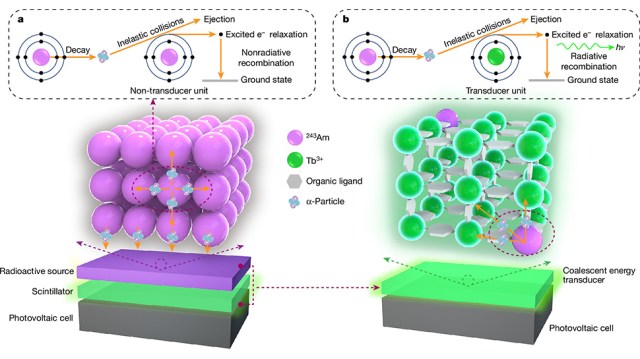
Traditional micronuclear batteries have faced challenges with low energy efficiency due to severe self-adsorption during alpha decay. Addressing this issue, the Chinese research team has developed a novel architecture that incorporates 243Am into a luminescent lanthanide coordination polymer.
By combining this new design with a photovoltaic cell to convert autoluminescence into electricity, the radiophotovoltaic micronuclear battery achieves a power conversion efficiency of 0.889%, delivering 139 microwatts per curie. Although the power output remains tiny, the potential for a long-term, maintenance-free energy supply is considerable.
The resilience of this battery is noteworthy, as radioactive decay remains consistent regardless of environmental factors such as temperature or pressure. This stability ensures a reliable power source in challenging conditions.
The technology is still in its early stages and requires further development before widespread adoption is feasible. However, the team suggests initial applications for the americium-based nuclear battery could target small, remote devices, particularly in deep space exploration, where replacing conventional batteries is impractical.
The research findings were published in the journal Nature.
More from TechRadar Pro
Scientists from across several Chinese institutions have unveiled a new ultra-compact nuclear battery that has the potential to replace the existing power sources used in everyday tech. Powered by Americium, this new battery reportedly achieves an energy conversion efficiency up to 8,000 times greater than previous models, suggesting it could…
