Researchers design tech that could ‘potentially replace solar cells’ in certain applications — novel supercapacitor is charged by light and could appear in a smartphone near you

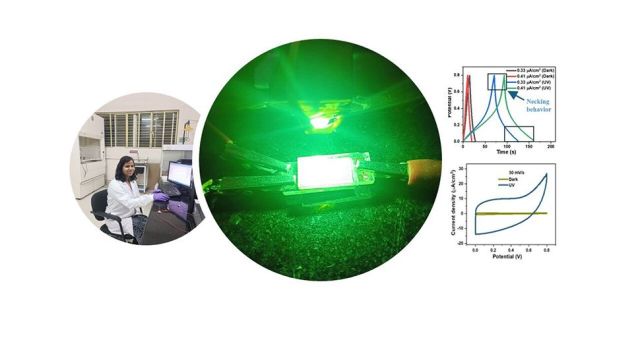
Researchers at the Department of Instrumentation and Applied Physics (IAP), Indian Institute of Science (IISc) and collaborators have developed a new supercapacitor that can be charged by light.
This innovation could be used in streetlights and self-powered electronic devices, including sensors, as unlike standard capacitors, which store energy electrostatically, supercapacitors use electrochemical methods to hold significantly more energy, allowing them to “release charge more quickly than batteries,” explained Abha Misra, Professor at IISc’s Department of Instrumentation and Applied Physics, and the study’s author.
The supercapacitor’s electrodes are made from Zinc Oxide nanorods on a transparent Fluorine-doped Tin Oxide substrate, allowing light to pass through and charge the device. When exposed to ultraviolet (UV) light, the supercapacitor demonstrated a large increase in capacitance – its ability to store electrical energy. “The ideas were simple… but when combined together, they worked very well,” Misra adds.
Necking behavior
In addition to the impressive increase in capacitance, the researchers discovered two unusual behaviors. First, the device’s capacitance increased with voltage under light exposure, a phenomenon co-author AM Rao from Clemson University refers to as “necking behavior.” Second, while energy storage typically decreases when charging faster, the team found that their supercapacitor stored more energy during rapid charging when exposed to UV light.
The research team used a liquid electrolyte to improve performance by enhancing the electric double layer effect, which plays a key role in the high energy storage capacity of supercapacitors. “We have miniaturized supercapacitors to the micron scale so that they can be integrated along with microelectronic chips,” Misra notes, pointing to potential applications in mobile phones and other small devices.
Misra believes this new technology could eventually replace solar cells in streetlights due to its faster charging time and high power density.
The research was published in Journal of Materials Chemistry A, and the team hopes to further develop the supercapacitor to charge using visible and infrared light.
More from TechRadar Pro
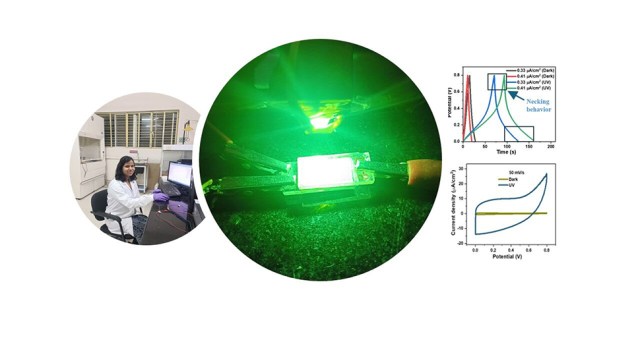
Researchers at the Department of Instrumentation and Applied Physics (IAP), Indian Institute of Science (IISc) and collaborators have developed a new supercapacitor that can be charged by light. This innovation could be used in streetlights and self-powered electronic devices, including sensors, as unlike standard capacitors, which store energy electrostatically, supercapacitors…
