Honda and Nissan invite Mitsubishi to join their EV development partnership

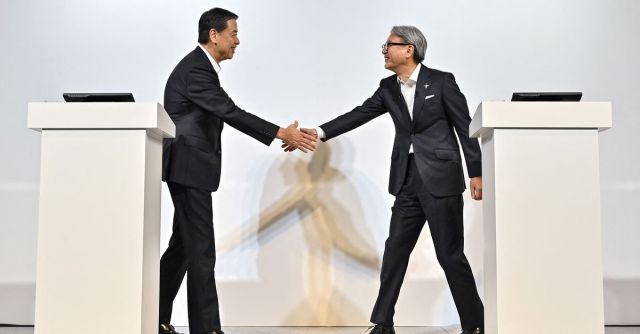
Mitsubishi signed a memorandum of understanding with Nissan and Honda to join their pre-existing partnership to jointly develop electric vehicles and other related tech. The hope is that by working together, the three Japanese automakers can catch up to their rivals in the race to introduce more technologically advanced vehicles in the future.
It’s another example of big, global automakers pooling their resources in the interest of defraying costs and finding more efficient ways to introduce new EVs to the marketplace. The inclusion of Mitsubishi “will not only add new knowledge and strengths but will also provide further synergies that can only be generated by the three companies,” Nissan and Honda said in a statement.
It’s another example of big, global automakers pooling their resources in the interest of defraying costs and finding more efficient ways to introduce new EVs
This is not the first joint venture for any of these companies. Honda paired up with General Motors to jointly develop EVs, only to dissolve the partnership several years later. (The newly released Honda Prologue is built on GM’s Ultium platform.) Several months later, Honda teamed up with Nissan with similar goals in mind. And Nissan is already part of a decadesold global alliance with Mitsubishi that also includes Renault.
Honda was likely looking for a partner to help take the reins after exiting its deal with GM. Likewise, Nissan and Mitsubishi are both struggling to find a foothold in the US, with the former’s operating profits sinking roughly 99 percent in the US last quarter. Americans just aren’t buying Nissans like they used to, and the company’s failures to introduce any hybrids in what is clearly a very hybrid-friendly market is also slowing things down.
It’s not clear what Mitsubishi really brings to the table. The brand has also struggled to introduce any long-range EVs, but that isn’t unique to Japan’s auto industry. The plug-in hybrid Outlander has had some success but isn’t exactly a runaway hit.
In other news, Nissan and Honda are adding another goalpost for their partnership: developing a so-called software-defined vehicle. The two companies say they will conclude research into new technologies, with the goal of moving to mass production in a year’s time. Honda and Nissan will also work together on batteries, electric motors, and a new product review system to encourage “mutual vehicle complementation.”
Speeding up the process in which many other companies already have a steady lead seems to be the name of the game here. Nissan already has outlined its plans to electrify 16 of the 30 vehicles it produces by 2026, seven of which for the North American market. And it’s making progress on its solid-state battery plans.
Now all it needs is partners willing to help spread those costs around and staunch the bleeding it’s experiencing today. And in Honda and Mitsubishi, it found them.
Mitsubishi signed a memorandum of understanding with Nissan and Honda to join their pre-existing partnership to jointly develop electric vehicles and other related tech. The hope is that by working together, the three Japanese automakers can catch up to their rivals in the race to introduce more technologically advanced vehicles…
