E-commerce is driving up pollution near warehouses

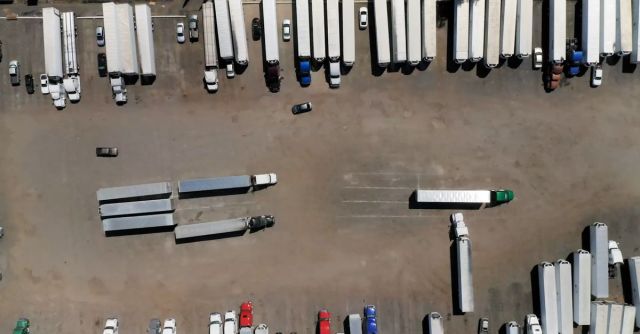
The data is in, and it shows a significant rise in air pollution where e-retailers build their warehouses, and the neighborhoods hit the hardest have more people of color living in them.
Warehouses have mushroomed across the US with the rise of e-commerce — creeping closer to Americans’ homes and becoming more common than office buildings. They’re there to store, sort, and send off packages that wind up at our doorsteps seemingly out of thin air. In reality, that flurry of activity sends fleets of trucks and delivery vehicles through communities, affecting neighborhoods closest to warehouses the most.
“I would argue that it’s a very meaningful, impactful amount.”
The first nationwide study of its kind linked truck traffic from warehouses to an increase in an air pollutant called nitrogen dioxide. Nitrogen dioxide is a key ingredient in smog and, on its own, can aggravate respiratory diseases, including asthma. Neighborhoods downwind of warehouses, less than 5 miles (roughly 7 kilometers) away, experienced a nearly 20 percent increase in NO2 pollution compared to neighborhoods upwind of warehouses.
“I would argue that it’s a very meaningful, impactful amount [of NO2 pollution],” says lead study author Gaige Kerr, an assistant research professor at George Washington University’s Milken Institute School of Public Health. The spike in pollution is essentially equivalent to wiping out several years’ worth of efforts to improve air quality under the Clean Air Act, according to Kerr. (Kerr also serves as a consultant for the nonprofit Environmental Defense Fund, the Department of Justice, and the California Air Resources Board.)
The study, published in the journal Nature Communications, encompasses the locations of nearly 150,000 large warehouses across the contiguous US gathered from a commercial database. They found a 117 percent increase in the total number of new warehouses built between 2010 and 2021. And compared to older warehouses, newly constructed facilities are bigger — with far more loading docks and parking spaces to accommodate more vehicles around the clock. Clusters of warehouses also became more common — crowding out residents in some towns, The Verge has previously reported. Truck traffic and NO2 pollution increased with the number of loading docks and parking spaces.
Communities of color are particularly vulnerable to air pollution from warehouse traffic, the researchers found. The proportion of Asian and Hispanic residents was close to 290 percent and 240 percent higher, respectively, in areas with the most warehouses compared to the median nationwide. Notably, just 10 counties in California, Texas, Illinois, Florida, Arizona, and Ohio were home to 20 percent of all the warehouses.
A big breakthrough in satellite remote sensing enabled a closer look at nitrogen dioxide for this study. There aren’t enough ground sensors for NO2 in the US to capture differences in pollution levels from block to block. But the study authors were able to gather data on nitrogen dioxide in 2021 from a European Space Agency (ESA) satellite instrument that takes daily readings as it orbits around the planet.
That gives scientists and health advocates an unprecedented look at tailpipe pollution surrounding warehouses. But it might still lead to an underestimate of the problem, the study notes. The satellite takes readings once a day in the afternoon, local time. But warehouse traffic tends to peak in the morning. The researchers are hopeful that a new satellite instrument from NASA, launched last year to monitor air pollution, could provide even more precise data. Unlike the ESA satellite, NASA’s instrument will stay in geostationary orbit to take hourly readings over North America. (NASA funded the study published today.)
Neighborhood activists have fought for years to stop warehouses from being built too close to homes and have called on e-retailers to switch to electric vehicles to alleviate pollution. They’ve also pushed some local regulators to consider regulating emissions near warehouses more similarly to factories or other industrial facilities with smokestacks. Warehouses have been a blind spot for many regulators in the past because the buildings themselves don’t create pollution — they attract pollution from trucks, trains, and cargo planes. But a growing body of research like this study is helping to make the potential environmental and health costs of e-commerce more clear.
The data is in, and it shows a significant rise in air pollution where e-retailers build their warehouses, and the neighborhoods hit the hardest have more people of color living in them. Warehouses have mushroomed across the US with the rise of e-commerce — creeping closer to Americans’ homes and…
