You and your friends can now share and remix your favorite conversations with the Claude AI chatbot

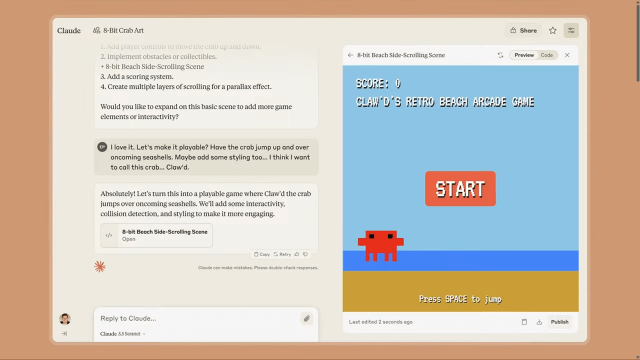
Anthropic has released the Artifacts feature teased recently for its Claude generative AI chatbot, allowing users to publish, share, and even remix AI-generated content with one another. Artifacts sit as standalone pieces of content produced by Claude, including documents, images, code, and even interactive displays.
Moreover, you can now make your Artifact public and see those created by others with shareable links, like the shareable ChatGPT links. However, this isn’t just a chance to see someone else’s conversations with an AI chatbot – you can also remix them.
Essentially, you can open published Artifacts created by others and modify or build upon them through conversations with Claude. Anthropic is pitching it as a way to foster a collaborative environment by iterating on the Claude-created content. The Artifacts feature is powered by Claude 3.5 Sonnet, Anthropic’s latest AI model. According to the company, this latest AI model outperforms recent models like GPT-4o and Google’s Gemini 1.5 on various benchmarks.
When a user decides to remix an Artifact, a new conversation in Claude is created, incorporating the original content. From there, the user can modify, expand upon, or use the Artifact as inspiration for their own projects.
To remix an Artifact, users simply need to find the “Remix this Artifact” button when viewing a published piece. Clicking this button initiates a new conversation in Claude, where the original content is loaded and ready for modification. This capability transforms static AI-generated content into dynamic, evolving pieces, even if that just means playing with a picture of a crab or making it the star of a simple video game.

AI Remix
To assuage privacy and control concerns, Anthropic allows users to unpublish a specific version of an Artifact anytime by revisiting the relevant Claude conversation and selecting the unpublish option. Additionally, if a conversation containing a published Artifact is deleted, the public version of that Artifact is also removed.
Importantly, publishing or unpublishing one version of an Artifact does not affect other versions. This flexibility allows users to manage multiple iterations of their content without disrupting collaborative efforts or losing progress.
Anthropic sees the remix option as particularly useful for developers, content creators, and educators who can now build upon existing AI-generated content, enhancing it to suit their unique requirements. For users new to Artifacts, clicking “Remix this Artifact” will automatically enable this feature on their account. If you don’t already have a claude.ai account, you’ll be prompted to sign up as you need one.
Anthropic’s move to encourage collaboration with AI conversations fits the developing culture for AI content. Though Anthropic’s models are closed, the iterative nature of the Artifact remixing mirrors the open-source movement in software development, where transparency and collective improvement drive innovation. As AI continues to integrate into more aspects of daily life and work, features like these will be essential in harnessing its full potential.
You Might Also Like
Anthropic has released the Artifacts feature teased recently for its Claude generative AI chatbot, allowing users to publish, share, and even remix AI-generated content with one another. Artifacts sit as standalone pieces of content produced by Claude, including documents, images, code, and even interactive displays. Moreover, you can now make…
