New video of ‘revolutionary’ ceramic storage technology emerges — Cerabyte’s improved prototype gives me hope that affordable Exabyte-class storage racks are coming sooner than expected

Storing huge amounts of data poses is increasingly posing serious challenges, such as escalating costs, increased complexity in data management, potential security breaches, and difficulty in quickly accessing or analyzing the accumulated data.
It also poses considerable environmental concerns due to energy consumption, but startup Cerabyte has a solution to this problem which involves writing data onto ceramic nanolayers, a method the company likens to ancient Egyptians’ practice of chiseling hieroglyphs into rock.
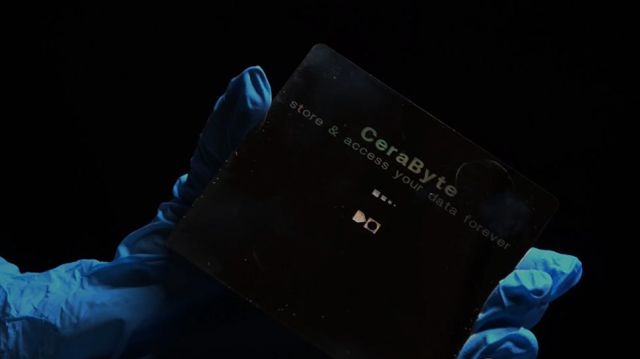
Cerabyte’s prototype comprises one read rack and several library racks. The storage media takes the form of a thin, single accessible square glass sheet (referred to as a platter or carrier) with a nanoscale dark ceramic layer stored in cartridges within a robotic library. Data is inscribed in QR code-like patterns onto the ceramic using a femtosecond laser pulse.
A wait ahead
A new video of the system in action has surfaced on YouTube which you can watch below. Previous reports suggested the cartridges could store up to 10,000TB each, but that isn’t the case.
A spokesperson from Cerabyte told us, “This is a data density which is justified by experiments and part of our roadmap when we switch from laser beam to particle beam, but not within the next 5 years.”
They further explained, “For our prototype we used only commercial-off-the-shelf components in order to quickly demonstrate the feasibility of the technology. Generally speaking, we leverage amortized semiconductor fab tools. This means, the setup today builds on maskless lithography developed 10+ years ago. The particle beam technology for the semiconductor technology today (costing 100+ mio) will be the basis for write/read processes in 10 years from now. Then EB/rack and costs of far below of $1/TB/month will be possible. The main challenge of data storage today is the flattening curves of development, hence performance and costs.”
While 10,000TB cartridges might not be right around the corner, the spokesperson did give us some good news. “We are currently improving the data density by using a UV laser and have therefore increased the data density by three times compared to our initial setup. This was a major breakthrough to be capable to ablate the data layer.”
More from TechRadar Pro
Storing huge amounts of data poses is increasingly posing serious challenges, such as escalating costs, increased complexity in data management, potential security breaches, and difficulty in quickly accessing or analyzing the accumulated data. It also poses considerable environmental concerns due to energy consumption, but startup Cerabyte has a solution to…
