Microsoft’s billion-dollar OpenAI investment was trigged by Google fears, emails reveal

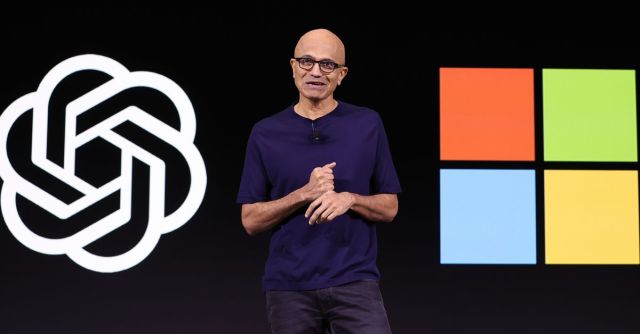
Microsoft invested $1 billion in OpenAI in 2019 because it was “very worried” that Google was years ahead in scaling up its AI efforts. An internal email, titled “Thoughts on OpenAI,” between Microsoft CTO Kevin Scott, CEO Satya Nadella, and co-founder Bill Gates reveals some of the high-level discussions around an investment opportunity in the months before Microsoft revealed the partnership.
The email was released on Tuesday as part of the ongoing US Justice Department antitrust case against Google, Business Insider reports.
“We are multiple years behind the competition in terms of machine learning scale,” Scott writes in his June 12th, 2019, email to Nadella and Gates. He details how it took six months for Microsoft engineers to replicate Google’s BERT language model and get it trained “because our infrastructure wasn’t up to the task.”
Microsoft was impressed by Google’s early use of AI
Scott says he was initially dismissive of AI efforts at OpenAI and Google DeepMind when the companies were competing to see who “could achieve the most impressive game-playing stunt” — a clear reference to Google DeepMind’s AlphaGo Zero demos. Scott quickly became more impressed when things moved toward natural language processing models. “As I dug in to try to understand where all of the capability gaps were between Google and us for model training, I got very, very worried,” Scott wrote.
Some of Google’s early AI models helped it have a competitive advantage against Bing, said Scott, and he even praised Google’s autocomplete features in Gmail that were “getting scarily good” in 2019.
Nadella responded to Scott’s thoughts on OpenAI by forwarding it to Microsoft CFO Amy Hood, noting that this is “why I want to do this.” Hood is a key member of Microsoft’s senior leadership team and is tasked with overseeing the company’s financial goals and regularly keeping Microsoft’s spending in check.
The email thread, which you can read below, is heavily redacted and appears to be a reply to either Nadella or Gates. While Gates stepped down from the Microsoft board in 2020 amid an investigation into an affair with an employee, he’s reportedly still been a big part of Microsoft’s ongoing relationship with OpenAI. It’s not clear from this internal email who initiated the discussion about OpenAI in 2019, but Business Insider reported earlier this week that Gates had been regularly meeting with OpenAI since 2016 and helped broker the deal.
Microsoft has now invested more than $13 billion in OpenAI, adding its models to Office apps, its Bing search engine, Edge, and even inside its Windows operating system. It has helped Microsoft be seen as more of a leader in AI, instead of falling behind as it once feared five years ago. Nadella also recently made AI and security his top two areas of focus for Microsoft in 2024 and beyond, signaling that the rollout of AI features in Microsoft products isn’t about to slow down.
Microsoft invested $1 billion in OpenAI in 2019 because it was “very worried” that Google was years ahead in scaling up its AI efforts. An internal email, titled “Thoughts on OpenAI,” between Microsoft CTO Kevin Scott, CEO Satya Nadella, and co-founder Bill Gates reveals some of the high-level discussions around…
