World’s fastest broadband connection went live down under — Nokia demos 100 gigabit internet line in Australia in record-breaking attempt but doesn’t say when it will go on sale

Faster broadband is on the way, and it won’t require network providers to overhaul their infrastructure.
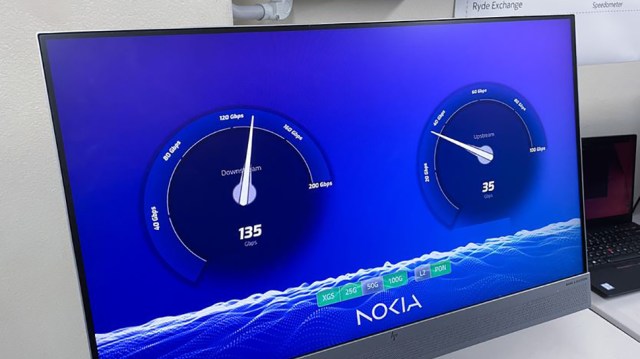
nbn, the largest wholesale broadband provider in Australia, used Nokia’s Lightspan MF fiber platform, to deliver 10G, 25G, 50G and 100G broadband speeds over its existing fiber network. Nokia’s Lightspan delivers next-generation Passive Optical Network (PON) at scale.
PON is a type of fiber-optic network that combines point-to-multipoint fiber architecture with communications networking. The technology works by using a single fiber-optic connection that divides into many distinct fibers, allowing one line to serve multiple users. This is achieved through both active and passive splitters, hence the name. PON technology boosts the efficiency of a network because it reduces the number of active switching devices used. Furthermore, it requires less power and supports greater distances between users and their service providers.

A game-changer
There are a number of different types of PON technologies, including Gigabit Passive Optical Network (GPON), Ethernet Passive Optical Network (EPON), and next-generation PON like XG-PON (10 Gigabit PON) and NG-PON2 (40 Gigabit PON). Nokia’s Lightspan supports a full range of PON options.
Geert Heyninck, vice president of broadband networks at Nokia, said: “There is a huge opportunity for operators to leverage their existing fiber broadband networks to efficiently add advanced services which goes way beyond consumer services. Think enterprise, mobile backhaul, Smart City, industry 4.0. It’s important for service providers to have choices to match the right speed and cost points to meet the different use cases and market requirements they may have. As the industry’s first and only solution capable of supporting the full range of PON technologies from 10G to 25G, 50G, and even 100G, we can give operators the freedom and flexibility they need to meet their business needs while also helping to optimize network performance and reduce costs.”
The trial highlighted the ease with which operators can upgrade the 10G PON to a symmetrical 25G PON and subsequently to 50G PON or 100G, using identical passive and active fiber components. This network evolution could be game-changing in delivering an enhanced digital experience for users, but there’s currently no word on when we can expect it to become widely available.
More from TechRadar Pro
Faster broadband is on the way, and it won’t require network providers to overhaul their infrastructure. nbn, the largest wholesale broadband provider in Australia, used Nokia’s Lightspan MF fiber platform, to deliver 10G, 25G, 50G and 100G broadband speeds over its existing fiber network. Nokia’s Lightspan delivers next-generation Passive Optical…
