One thing that confounds me after reading Cixin Liu’s The Three-Body Problem and watching its Netflix adaptation is a simple button.
3 Body Problem stars on the show’s big question: would you push the button?

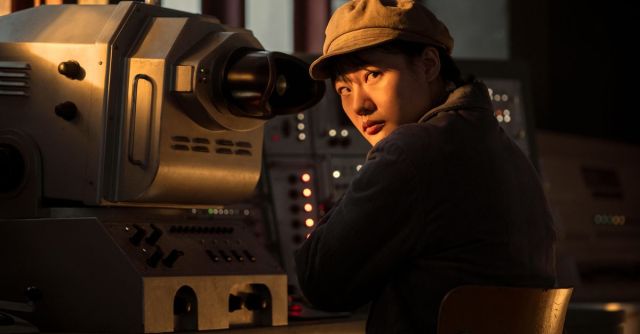
Spoilers for 3 Body Problem to follow.
I still haven’t been able to wrap my head around why Ye Wenjie, when faced with the choice to respond to or ignore transmissions from the San-Ti, an alien race, chose to respond. Throughout human history, first contact events rarely go well and go even worse when the two sides are technologically imbalanced. So, why would an ostensibly hyperintelligent woman pin her hopes on a race of beings that have already made their hostile designs on Earth clear?
In an interview with Ye’s actresses Rosalind Chao and Zine Tseng, who play the character throughout the different stages of her life in the Netflix series, I decided to ask what they thought of Ye’s actions and what they would do if faced with her choice to push the button.
“Naivety is what leads to her fateful act,” Chao said. Before her choice, Ye faced incredible trauma. She watched as her father, a prominent physicist and college professor, was beaten to death in one of the infamous struggle sessions of Mao’s Cultural Revolution. That same revolution left Ye, herself a physicist, without a future as China transforms into a country where her experience in the sciences is seen as subversive — a threat to Mao’s repressive, anti-intellectual regime. She becomes trapped, bound in service as a research scientist to the government that killed her father. “She thinks that the entire world is experiencing what she’s experiencing, and she has an opportunity to make it better,” Chao said.
What, though, does “better” mean in this context?
Ye was warned by a sympathetic San-Ti individual that continued communication would prompt the entire race to invade. Knowing this, she still pushes the button. I asked Chao and Tseng if Ye’s desire to make the world “better” was born of the hope for salvation or the spite of wanting to see the world that hurt her destroyed.
“There is spite, and there is hope,” Tseng answered. Though Ye inevitably presses the button, she does pause before doing so. “I felt hope was [contained in] the hesitation.” Chao sees The Great Button Press as a more neutral action. “[Pushing the button] has the seasoning of spite,” she said. “But it impels her forward.”
Understanding Ye’s actions means understanding someone who has been indelibly shaped by the events of China’s Cultural Revolution. According to Tseng, Ye’s survival of that period is due to her strength. “She’s one of the strongest people in that period of time,” Tseng said. “She’s been through so many life-threatening events, but she’s alive.”
Tseng said Ye’s capacity for survival is what attracts her the most to that character. For Chao, it is Ye’s adaptability. “She adapts to the circumstance according to what serves her and what she perceives as serving humanity,” Chao said.
Ye’s choice has dire consequences for both humanity and herself. She loses everything and everyone she hoped to save, including her own life, behind her transmission to the San-Ti. It’s hard to feel sympathy for someone suffering the consequences of a choice when those consequences were at least hinted at, if not stated clearly, upfront. But Chao feels that’s where her greatest lesson from 3 Body Problem lies. “What I’ve really learned from the 3 Body Problem is a certain kind of empathy,” Chao said. “There’s so many shades of gray, and one never knows what makes someone do an action that can be perceived as wrong or a mistake.”
Chao said that when she read The Three-Body Problem, she came away with an understanding of Ye as a character. But it was only through portraying her that she was able to develop empathy for this doomed woman. “It opened up my way of thinking,” Chao said.
Her answer was striking to me. I can’t seem to muster the same feelings for Ye, but I wondered if empathy for her would lead her actresses to make her same decision.
Tseng was practical in her answer, refusing to press the button. “I take advice,” she said. “Because they said, ‘Do not reply.’” Chao, however, disagreed. “If I had gone through everything that Ye had gone through,” Chao said, “how could I not push the button?”
While I still can’t fathom Ye Wenjie and her choice and the choices of a lot of other characters in 3 Body Problem, I am left with a better understanding of why.
“If somebody tells me don’t,” Chao said with a laugh, “I want to do it even more.”
One thing that confounds me after reading Cixin Liu’s The Three-Body Problem and watching its Netflix adaptation is a simple button. Spoilers for 3 Body Problem to follow. I still haven’t been able to wrap my head around why Ye Wenjie, when faced with the choice to respond to or…
