Europe’s space agency prepares to blot out the Sun

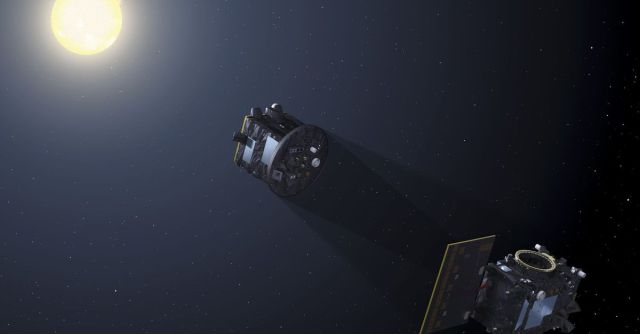
The European Space Agency (ESA) is preparing to create its own solar eclipses so that researchers can study one of the more difficult-to-observe parts of the Sun’s anatomy: its blazing-hot corona. To do that, it hopes to fly two separate spacecraft, 150 meters apart and aligned so that one satellite (called the “occulter”) blocks all but the corona from the other satellite, which will observe it using an instrument called a coronagraph.
The mission’s two craft will have to fly “in precise formation down to millimetre accuracy,” using satellite navigation, radio-based satellite interlinks, cameras, and a laser beam reflected between them. ESA technology director Dietmar Pilz said in a statement that getting the two to “act as if they are one enormous 150-m long instrument” will be an “extremely technical” challenge. The ESA says it’s targeting six-hour eclipse observations for each of the crafts’ 19-hour, 36-minute orbits.
One reason scientists are so eager to study the Sun’s corona is its role in our solar system’s weather. Aside from being mysteriously hotter than the Sun’s surface, it contributes to solar wind, and its coronal mass ejections have potential effects on Earth, ranging from the dancing lights of the planet’s auroras to widespread electrical outages (recall every headline you’ve seen predicting a solar storm-induced internet apocalypse). The ESA says one of the goals of the mission, known as Proba-3, is to measure the Sun’s total energy output to inform climate modeling.
There are coronagraphs on Earth and in space, but the ESA says they’re limited in what they can accomplish because the light has a tendency to diffract or spill over the edge of the light-blocking disk. Putting the occluding disk farther away helps, but building that into a single spacecraft isn’t practical. The ESA says in its release that NASA attempted to pull something similar off by using an Apollo capsule to block out the Sun for a Soviet Soyuz spacecraft in 1975.
The agency hopes to launch the Proba-3 mission in September. Its release today comes as much of the US is getting ready to watch on April 8th as the ultimate occulter — the Moon — traverses the Sun and creates a total eclipse that will swing from South Texas to Maine.
The European Space Agency (ESA) is preparing to create its own solar eclipses so that researchers can study one of the more difficult-to-observe parts of the Sun’s anatomy: its blazing-hot corona. To do that, it hopes to fly two separate spacecraft, 150 meters apart and aligned so that one satellite…
