Hyundai’s Ioniq 5 N performance EV is coming March 2024

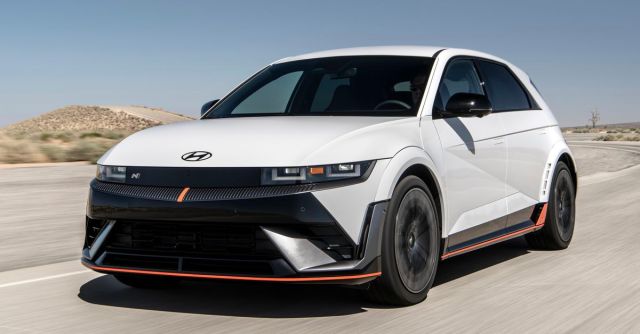
Hyundai showed off its production performance-variant Ioniq 5 “N” at the LA Auto Show this week, releasing final specifications of the electric crossover and announcing its availability at US dealerships in March 2024.
As previously announced in July, this new version of the Ioniq 5 was built by Hyundai’s performance tuning teams under its N sub-brand. The engineers behind the 2025 Ioniq 5 N used Hyundai’s base E-GMP electric vehicle platform, adding motorsport tech learned from the automaker’s “rolling labs” experiment vehicles like the N Vision 74, RM20e, and the RN22e.
Hyundai includes features for habitual motorheads like the N e-shift, which mimics the feeling of simulating an eight-speed dual-clutch transmission gas car, and the N Active Sound-plus which makes fake engine noises.
The exterior of the N doesn’t look too different from the regular Ioniq 5, but the subtle changes are certainly enough to make it enticing and stand out. It does include N badges in the front, rear, and near the rear wheel well, plus you get that orange soul patch strip in the center of both the front and rear bumper, an orange skirt, and a new mesh up front that allows for more airflow. The Ioniq 5 N is lowered by 0.79 inches, is wider at the bottom by two inches to fit the big 21-inch wheels and tires, and is 3.2 inches longer to accommodate the rear diffuser.
Hyundai revealed the full interior of the vehicle, too, and it’s enhanced with a bunch of N details, including on the steering wheel and peeking from the back opening of the bucket seats. The seats have reinforced bolsters, and there are knee pads and shin support at the center console to make sharp turns more comfortable. You also get USB-C ports and a wireless charging pad.
The Ioniq 5 N is equipped with a larger 84kWh battery pack (compared to 77.4kWh on the SE, SEL, and Limited models), but Hyundai wouldn’t share the drivable range until closer to launch. The battery can charge from 10 to 80 percent in 18 minutes and has a max charging rate of 238kW.
The vehicle has a two-stage inverter that aids in pushing the dual motors to a maximum 478kW (641 horsepower) output. That max power is achieved on the special “N Grin Boost” mode, which can be activated on the touchscreen or automatically when in launch mode. The N can accelerate from 0–60 mph in 3.25 seconds.
The thermal management system has been upgraded to include independent radiators for the battery and motors, a conductivity channel to move heat away from cells, and better motor oil cooling, plus a battery chiller. Hyundai says the system “boasts a higher resistance to heat-induced power degradation” compared to competitor performance EVs.
Since the Ioniq 5 N is built for the track, it’s further stabilized with 42 additional welding points and has extra adhesives holding parts together. This gives the vehicle more rigidity for track use and drifting. Hyundai says the N has “rally-inspired” handling and has a rack-mounted motor-driven power steering system with a quick steering ratio and enhanced torque feedback. The EV’s one-pedal driving system, called “N Pedal,” aids drivers in cornering with a strong decelerating force while still providing some energy regeneration.
Hyundai showed off its production performance-variant Ioniq 5 “N” at the LA Auto Show this week, releasing final specifications of the electric crossover and announcing its availability at US dealerships in March 2024. As previously announced in July, this new version of the Ioniq 5 was built by Hyundai’s performance…
