HTC’s Vive Focus 3 has a new, far-out mission: astronaut mental health

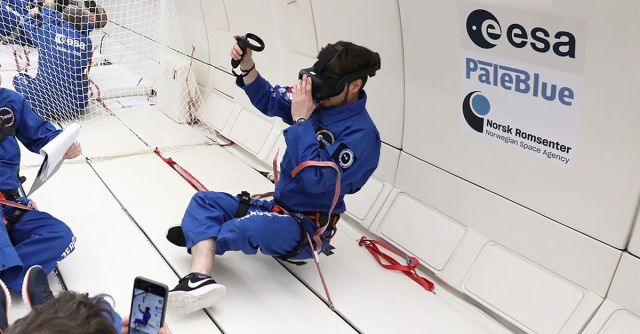
HTC is going to space. The company announced today that on a planned November 7th NASA resupply launch, a tweaked, microgravity-friendly version of its Vive Focus 3 VR headset will be sent to the International Space Station. Once it’s there, Danish astronaut Andreas Mogensen will test the Focus 3’s viability for helping alleviate the mental stress that NASA says comes from the “lack of privacy, high and variable workloads, and separation from loved ones” inherent to work in space.
HTC partnered with a virtual reality therapy company called XRHealth to work on a “virtual assistance mental balance initiative” by aeronautics R&D company Nord-Space ApS to try to meet astronauts’ unique needs. HTC believes its tweaked headset Vive Focus 3 won’t make astronauts become disoriented or lose their lunch unlike past attempts at using VR in space, where the lack of gravity needed to give a VR headset its directional frame of reference can become nauseatingly out of sync with its wearer’s movements.
Thomas Drexmier, HTC Vive’s assistant vice president, told The Verge in an interview that, besides software changes and some necessary power management adjustments, the Vive Focus 3 Mogensen will test is otherwise the same one it sells here on Earth.
The company says it addressed the spatial orientation problem in software, tying its tracking algorithms to one of the controllers, which is stationary and tracked by the cameras and proximity sensor of the headset. That gives the Focus 3 the relative positioning it needs to match its motion to the wearer. At the same time, the wearer can navigate menus either using eye-tracking or the other controller.
The months-long stay will be a big test of whether HTC’s approach works. Until now, HTC says the headset has only been weightless for about 20 seconds at a time, during the simulated orbital freefall aboard parabolic flights. If the Focus 3 proves resilient on this mission, it could open the door to a more robust space-based VR experience targeted at longer missions — including a possible two-year round-trip voyage to Mars.
Accompanying HTC’s tweaks on the mission is the VR software built by XRHealth. Eran Orr, the company’s founder and CEO, said that Mogensen will have access to about 10 primarily 360-degree videos, including some from Denmark, where he’s from, “with the idea of trying to give [him] a sense of home.” The software will also offer short breathing and meditation exercises, while further updates may bring more features after the headset is on the station.
But this, as with the Vive hardware, is only a test — there is no treatment aspect. It’s a “very small step forward,” Orr told me, “but the vision is a magnitude bigger than what we are doing now.” Eventually, XRHealth hopes for astronauts to use the headset to connect with people back on Earth, including therapists and coaches.
HTC is going to space. The company announced today that on a planned November 7th NASA resupply launch, a tweaked, microgravity-friendly version of its Vive Focus 3 VR headset will be sent to the International Space Station. Once it’s there, Danish astronaut Andreas Mogensen will test the Focus 3’s viability…
