Even Super Mario Bros. Wonder’s approach to difficulty is playful

When it comes to difficulty, most games like to put you in a bucket. At the start of the experience, you have to choose whether you want to play on a hard or easy mode, and usually, over the course of the game, you can move between these as you see fit, which is good because it’s hard to really know what mode is right for you at the beginning. Super Mario Bros. Wonder doesn’t force you to make this decision. It doesn’t have traditional difficulty settings at all. And yet, its approach to difficulty is one of the most refreshing I’ve ever seen — it’s both subtle and powerful and as playful as the rest of the game.
The most obvious form this takes is in the characters you can play as. The main cast of Mario and friends are all basically the same, but there are a handful of characters — Nabbit and all the various flavors of Yoshi — that serve as a default easy mode. None of them can be damaged, and in the case of Yoshi, you also get a better jump and an additional attack thanks to his extendable tongue. Other characters can ride on a Yoshi; I used this to great effect to piggyback my eight-year-old kid through some of the more perilous platforming sequences.
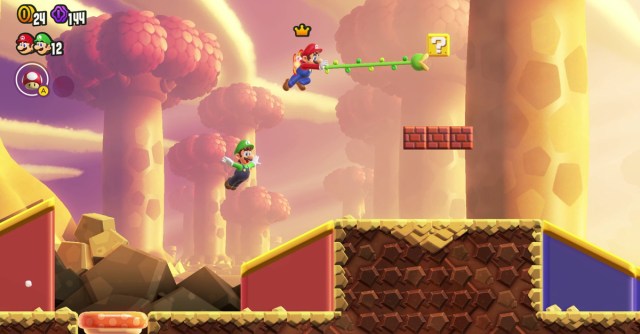
That’s a great start, but the game goes a few steps further. Most notable are the badges, which are special skills you can unlock and equip. You can only use one at a time, but they’re pretty powerful. Some give you a higher jump or faster run; one gives you a retractable vine that’s basically a grappling hook. Others are much more helpful for beginners: the “Add ! Blocks” badge inserts additional blocks to make platforming less stressful, while the “Safety Bounce” lets you bounce out of dangerous pits full of lava or spikes, but just once per fall.
And then there’s the structure of the game. Unlike some of its predecessors, Wonder doesn’t force you to go through its levels in a specific order. There are some stages you need to complete — like the boss battles, for instance — but you almost always have a few options to get to at any point in time. Some of the levels can be skipped altogether if you need to, and others can be completed in various degrees. You can make more progress by finding every secret, for example, but you definitely don’t have to in order to get to the end of the game. The levels also all have star ratings, so you know what you’re in for, letting you get mentally prepared for those four-star stages.
When you put all of these elements together, you get an experience that really lets you customize things how you want them. If you want to play like a traditional Super Mario game, you can skip the badges altogether. If you just need a little help, maybe you temporarily equip the grappling vine so you can make that one jump that’s been frustrating you for hours. Or maybe you’re a beginner who needs the extra blocks badge and the safety that comes from being Yoshi. It’s especially great in multiplayer, as the more forgiving characters help less-skilled players keep up with their buddies.
This kind of freedom provides a less binary approach to difficulty, and, just as important, it’s playful in a way that fits perfectly with Wonder, a game that’s brimming with creativity. It’s an experience that’s absolutely bursting with ideas — and that extends to finding ways to let everyone in on the fun.
When it comes to difficulty, most games like to put you in a bucket. At the start of the experience, you have to choose whether you want to play on a hard or easy mode, and usually, over the course of the game, you can move between these as you…
