Scientists transformed a cockroach into a remote-controlled zombie cyborg using an electrical backpack — and no, there’s absolutely nothing to be afraid of

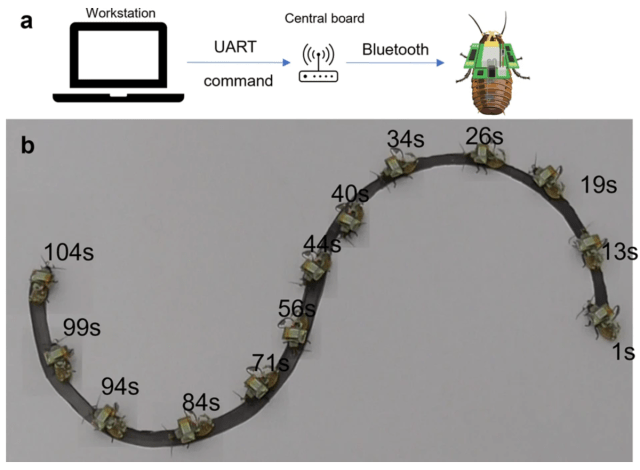
Mechanical engineers with the Nanyang Technological University in Singapore have created a remote-controlled cockroach using a pain-free method.
The aim? Use this novel technology to create an army of cyborg insects to explore the ruins in the aftermath of a disaster, or let us inspect aspects of our critical infrastructure that are difficult to reach.
The researchers used a new technology based around non-invasive electrodes – essentially attaching electrical backpacks to the cockroaches – to control them remotely in what they describe as a pain-free experience.
Using cockroaches in search and rescue
The team published their research in npj Flexible Electronics, spelling out exactly how they achieved the feat, and what the point of it all was.
“Centimeter-scale mobile robots recently received increasing attention due to the growing demand to work in confined spaces, such as exploration in urban post-disaster terrain and pipeline inspection,” the research paper said.
“Current robots at this scale mainly include robots composed of mechanical structures and cyborg insects.
“Despite the advantages of dynamics control, the former generally suffer from high energy consumption and poor adaptability to complex environments. In contrast, cyborg insects preserve the insect’s locomotion ability and adaptability to the environment, thus exhibiting low energy requirements.”
Previous attempts have been made, but they’ve all relied on embedding probes into the nervous system which, understandably, may have harmed and caused distress to the insects. The Nanyang Technology University research team even noted that harming the insects will have a disappointing impact on lifespan.
They relied on previous research that showed cockroaches could be manipulated by stimulating their antennae. They attached cuffs to each one and then created a layered gold and plastic sleeve to fit over each antenna. Next, they blasted these with UV light to shrinkwrap them.
Next, the researchers connected both sleeves to a backpack glued to the cockroach. They sent wireless signals to the backpack from a remote control, which delivered gentle jolts to either or both antennae. This triggered the insect to move in a particular direction. Another electrode, glued to the belly, could control the cockroach’s speed.
More from TechRadar Pro

Mechanical engineers with the Nanyang Technological University in Singapore have created a remote-controlled cockroach using a pain-free method. The aim? Use this novel technology to create an army of cyborg insects to explore the ruins in the aftermath of a disaster, or let us inspect aspects of our critical infrastructure…
