Here’s the (boring) solution that could make 100TB hard drives easier to build


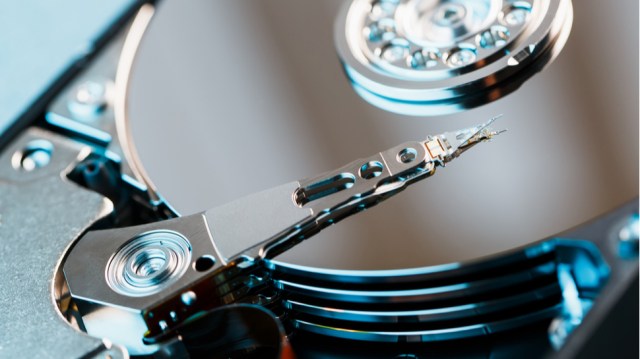
The next generation of HDDs, based on a technology known as heat-assisted magnetic recording (HAMR), could see significant performance gains thanks to an innovative media lubricant.
HAMR HDDs, developed by the likes of Seagate, have just hit the market after years of conceptualization, testing and prototyping; and hopes are high. In December 2020, Japanese researchers managed to tweak HAMR to deliver storage density that would allow 100TB HDD with the first 30TB HAMR HDDs shipping in April. Seagate also confirmed that 50TB hard drives are on its roadmap (before 2026).
The technology relies on storing information on rotating disks with a nanometer-thick media lubricant. But, according to Lei Li, professor of chemical and petroleum engineering at the University of Pittsburgh Swanson School of Engineering and Principal Investigator, the current industry standard lubricant isn’t fit for purpose.
Funding the next generation of HDDs
“In HAMR, media lubricant needs to have high thermal stability, high fly clearance, low surface tension and polar end groups that provide bonding to the substrate,” Li said.
“The state-of-art lubricant, perfluoropolyether, is not nearly thermally stable enough and usually results in lower fly clearance thus lower recording destiny. We need a lubricant that is capable of it all.”
The solution comes in the form of an ionic liquid, dubbed HFIL-OH, which has a lower surface tension and higher thermal stability.
Findings published in a recent paper show the ionic liquid is much better suited to surviving the high heats that HAMR HDDs subject the lubricant to, meaning HAMR technology could be closer to realizing its full potential.
The National Science Foundation has awarded him a $500,000 cash injection over the next two years to make this technology a reality. Seagate, too, will conduct drive-level industry testing to ensure HAMR HDDs built with HFIL-OH work in practice.
This project will begin in October 2023. But the technology won’t hit the market for at least five to ten years, Lei told TechRadar Pro. That said, once HFIL-OH is developed and embedded in HDDs, they could prove to be leagues ahead of today’s largest hard drives.
Whether end users will be able to plug these in their NAS systems or use these as external hard drives remain to be seen. Large capacity hard drives are destined to the data centers and hyperscalers and it would be surprising that going forward, all new high capacity hard drives would be limited to enterprise, something we’re seeing on the SSD side as well.
The biggest hard drive that can be purchased online are 22TB models which have been available for more than 18 months now.
More from TechRadar Pro
The next generation of HDDs, based on a technology known as heat-assisted magnetic recording (HAMR), could see significant performance gains thanks to an innovative media lubricant. HAMR HDDs, developed by the likes of Seagate, have just hit the market after years of conceptualization, testing and prototyping; and hopes are high.…
