Don’t hate on Ford’s big, gas-guzzling trucks, because they’re funding its electric future

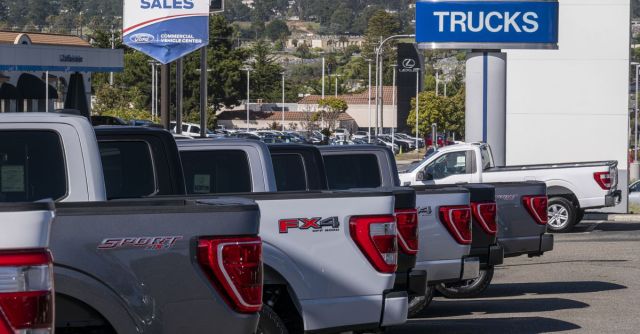
Ford’s electric future is being paid for by giant, gas-guzzling trucks and SUVs.
That fact came into stark relief this week during the company’s second quarter earnings report, in which the Blue Oval reported losing $1.1 billion before interest and taxes on its EV business, more than twice as much it lost over the same period last year.
Compare that to Ford’s profits in the sale of gas and hybrid trucks and SUVs: $2.3 billion before interest and taxes. Commercial vehicle sales also posted a healthy profit of $2.4 billion for the quarter.
Ford lost $1.1 billion on its EV business this quarter
At the time, Ford CEO Jim Farley framed it as a necessary move that will help it better compete with companies like Tesla that have the luxury of focusing on only one type of vehicle technology. He also noted that, for now and likely years to come, the profitable Ford Blue side of the business would be helping provide the cash to help pay for the Ford Model e side of the business.
Making electric vehicles is expensive. In addition to upgrading Ford’s existing factories, the company is also constructing several new facilities: a $3.5 billion battery facility in Marshall, Michigan; two additional battery factories in Kentucky; and a mega-campus vehicle assembly plant in Tennessee, which combined will cost $11.4 billion (a cost that Ford is sharing with SK Innovation).
And for Ford, the costs keep mounting. The company now expects to lose a total of $4.5 billion on its EV business for the entire year of 2023, up from a previous prediction of $3 billion in losses.
“While the shift to EVs is unquestionably underway, the last few weeks have shown us the adoption by early, majority customers will be a little slower than expected,” Ford’s chief financial officer, John Lawler, said on a call with investors.
Making electric vehicles is expensive
Slower, yes, but Ford is also hurting its EV business with repeated price cuts as it continues to wage a price war with Tesla. Also, production has been slower than expected, with temporary factory shutdowns for upgrades eating into the company’s ability to churn out enough EVs. Ford now expects to make 600,000 EVs by the end of 2024, a figure the company previously expected to hit by the end of this year. And demand is slowing, as new EVs sit on dealer lots unsold.
All of which is to say, there’s a long road ahead for Ford’s shift to electric vehicles. The company’s decision to jump aboard Tesla’s EV charging bandwagon and adopt the NACS (North American Charging Standard) for its future lineup may help assuage customers who were holding off on a purchase because of charging anxiety. And new products — the company currently only has two EVs, the Mustang Mach-E and F-150 Lightning — will attract new car buyers as well.
But in the meantime, Ford will need to continue to sell big gas-guzzlers that pollute communities and contribute to our increasingly warming planet in order to generate enough revenue that it can then turn around and funnel into producing more zero-emission vehicles. It’s the sad truth of the auto industry.
Ford’s electric future is being paid for by giant, gas-guzzling trucks and SUVs. That fact came into stark relief this week during the company’s second quarter earnings report, in which the Blue Oval reported losing $1.1 billion before interest and taxes on its EV business, more than twice as much…
