Black Mirror’s ‘Beyond the Sea’ is a slow-motion tragedy in the depths of space

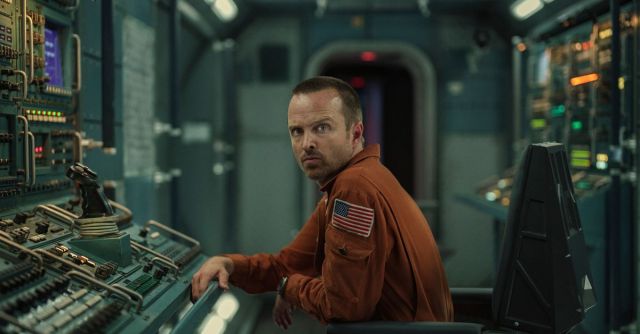
“Beyond the Sea” is the rarest breed of Black Mirror episode: the kind driven by empathy. Carried by a cast that includes Aaron Paul, Josh Hartnett, and Kate Mara, it’s equal parts character study and Twilight Zone creeping horror — a story focused less on the series’ typical social commentary than on three people whose impossible situation leads to an inevitably tragic end.
The episode is set in an alternate 1969 where two astronauts are midway through a six-year mission. Although their bodies are stuck in a cramped spacecraft, they spend most of their time inhabiting a pair of lifelike telepresence “replicas” on Earth. David (Hartnett) maintains an idyllic life with his wife and two children, taking his Neil Armstrong-esque celebrity graciously. Cliff (Paul) has a far more brittle relationship with his taciturn son and his lonely wife Lana (Mara), who he’s uprooted to live in a remote farmhouse. The mission proceeds smoothly until a horrific tragedy destroys David’s family and his replica. And to keep him from despair, Cliff lets David begin taking short jaunts in his body back home.
It’s immediately obvious this will end badly, and “Beyond the Sea” doesn’t subvert viewers’ expectations. Instead, most of its 80 minutes are devoted to the relationship between its three leads. David and Cliff start as foils: the former a charming, laid-back Californian, the latter a stiff, suspenders-wearing square. David works to develop a rapport with Lana — intuiting her unhappiness, recommending books — while Cliff is inattentive and withdrawn. But David’s misery calcifies into a growing resentment of Cliff, whose relationship with Lana proves stronger than it looks. Hartnett captures David as by turns suave, confident, and desperately lost, while Paul gives an understated performance playing (in replica form) both astronauts. Mara is similarly stoic, maintaining a sense of guarded composure even as the tension escalates.
Series creator Charlie Brooker has said “Beyond the Sea” was initially set in the near future, and the ’60s period setting could easily have felt like window dressing. There’s the occasional detail that feels a little too on the nose, like Lana passing her days by reading Valley of the Dolls. Pragmatically, though, it creates space for some vital suspension of disbelief — removing the technologies that would make its characters’ isolation less all-encompassing. (You still have to accept that mission control would have seemingly zero input on a massive disaster and be almost completely hands-off with its astronauts’ irreplaceable robot bodies.) The setting also pushes the episode into an unusually warm visual style, even in the vacuum of space. And it gives us a short but great appearance from Rory Culkin playing a stand-in for Charles Manson.
And to its credit, “Beyond the Sea” doesn’t lean on 60-year-old cultural norms to turn its characters into caricatures. Black Mirror’s default perspective is one of detached superiority: its best-known episodes are morality plays about unlikable people making stupid, cringeworthy choices under the dehumanizing influence of technology. But “Beyond the Sea” is strikingly generous toward Cliff and David, even as both men inflict suffering on each other and Lana.
That’s partly because they’re stuck in a terrible crisis that neither one chose or deserved. But it’s also because of Paul and Hartnett’s vulnerable performances and because Brooker’s script leaves space for us to interpret their motivations sympathetically. The episode subtly conveys how bizarre the replica experience must be, including suggestions that Cliff has a lingering discomfort with his android body. It leaves ambiguous how much any given act of kindness or coldness is actually just self-preservation; Cliff’s decision to isolate his family, for instance, becomes more understandable after David’s tragedy.
Several Black Mirror stories have explored the intersection of grief and synthetic bodies, and “Beyond the Sea” has shades of “San Junipero” and “Be Right Back” in particular. But the drama is unusually grounded in its performances rather than its premise. It’s less clearly metaphorical than something like “Be Right Back,” which used lifelike robots as an exaggerated stand-in for a loved one’s digital footprint. “Beyond the Sea” may be the kind of Black Mirror episode least likely to make viewers exclaim, “This is just like Black Mirror!” upon seeing some future dystopian technology — but that makes it one of the most satisfying episodes to watch for its own sake.
“Beyond the Sea” is the rarest breed of Black Mirror episode: the kind driven by empathy. Carried by a cast that includes Aaron Paul, Josh Hartnett, and Kate Mara, it’s equal parts character study and Twilight Zone creeping horror — a story focused less on the series’ typical social commentary…
