Amazon’s always-listening Bee wearable can now help you buy stuff

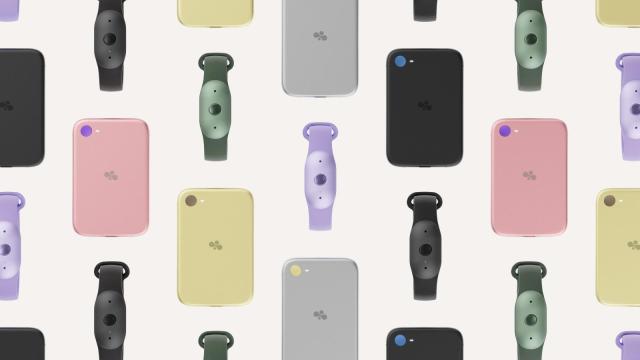
Last year, Amazon bought Bee, a relatively unknown startup with a $50 always-listening AI wearable that summarized every conversation you had. Today, the e-commerce giant is announcing two new Bee devices — and a new subscription to go with them. First is the $74.99 Bee Frontier, an updated version of the original Bee device. And coming soon is the $99.99 Bee Eclipse, a credit-card-shaped gadget that snaps magnetically onto the back of a smartphone.
Both devices are framed as gadgets to help you stay present in the moment. They listen to your daily conversations and then provide summaries, transcripts, insights, and to-dos based on what happens throughout the day. Conceptually, they’re similar to other AI note-taking gadgets like Plaud NotePin and Limitless AI. Users can also integrate Bee devices with services like Gmail, Google Calendar, Outlook, Apple HealthKit, and photos. Doing so lets Bee’s AI take some actions on your behalf, like drafting emails or sending calendar invites based on your conversations.
The main difference between the two products is form factor. The Bee Frontier can be worn as a Fitbit-like band on the wrist or as a clip-on pin. It’s been slightly redesigned from the prior model so that the recording button is more prominent, and it’s now available in three colors. Like the previous version, it has dual microphones, a recording indicator light, and roughly seven days of battery life on a single charge. It also has an IP67 water resistance rating.
Meanwhile, the Eclipse is meant as a non-wearable alternative and is envisioned for more professional use cases. Its larger size allows for a bigger battery, getting 21 days on a single charge. It, too, has a recording indicator light.
While these devices are free to use, Amazon is also introducing a Bee Pro subscription for $11.99 a month. The free tier gets users conversation summaries, recaps, and 14 days of memory. The subscription gets users “unlimited” summaries, suggested to-dos, daily memories, a personal chat assistant, conversation templates, third-party app integrations, and a desktop app. But the big marquee feature for the subscription is Amazon and Alexa Plus compatibility.
The Amazon integration is opt-in, and doing so will enable the device to surface shopping suggestions based on your conversations. For example, if your spouse asks you to buy cat litter, you might see a product card reminding you of that on your Amazon homepage or an Amazon button linking out to the product in the Bee mobile app. The Alexa Plus integration is meant to be a hands-free way to access your various Bee summaries and insights.
It’s an interesting time for Amazon to introduce these products, given the recent backlash against so-called surveillance tech. On that front, Amazon told The Verge in a press briefing that Bee devices encrypt transcripts, summaries, and to-dos via its “Private Compute” security architecture and don’t store audio recordings. Bee devices can also be programmed to automatically stop recording if no sound is detected after a certain period of time. As for whether transcripts are attributable, that depends. Upon setup, Bee’s AI is trained on the individual user’s voice. All other speakers are not automatically identified unless you ask them to also allow Bee’s AI to train on their voice. Whether that’s enough to assuage any privacy concerns, well, that depends on your definition of a recording.
The Bee Frontier is available starting today for $74.99 in black, green, and lavender. The Eclipse is “coming soon” for $99.99 and is available in black, pink, yellow, and silver.
Last year, Amazon bought Bee, a relatively unknown startup with a $50 always-listening AI wearable that summarized every conversation you had. Today, the e-commerce giant is announcing two new Bee devices — and a new subscription to go with them. First is the $74.99 Bee Frontier, an updated version of…
